

Your shopping cart is empty!
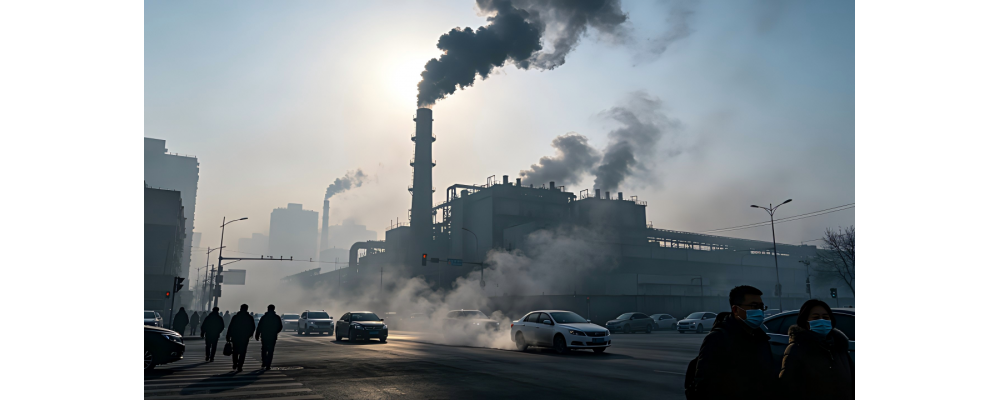
Invisible Risks, Visible Protection – Optosky Gas Monitoring Solutions
Optosky’s gas monitoring solutions combine UAV‑based GF910 for air pollutants (PM2.5, SO₂, NO₂) and GF330 NDIR analyzer for greenhouse gases (CO₂, CH₄, N₂O, SF₆, etc.). Fast, precise, and adaptable – making invisible risks visible for environmental protection.
On April 22, Earth Day, we reflect on how to better use spectroscopy to protect the land beneath our feet and the sky above us. From air and water to soil and forests, every part of the ecological environment carries hidden risks. Optosky launches a special feature on “Full‑Scenario Ecological Monitoring”, exploring these invisible changes from multiple dimensions. Gas monitoring is often the most direct and urgent link – colorless and odorless, yet far‑reaching; rapid to disperse, and difficult to control precisely. This article starts from gas monitoring and explores how spectroscopic technology can truly “make visible” the risks in the air.
01 Real‑World Challenges in Gas Monitoring: Invisible, Harder to Manage
- Concealed pollution sources, difficult traceability
Many pollution emissions are intermittent and mobile; traditional fixed monitoring stations find it hard to quickly pinpoint them.
- Limited monitoring methods, delayed response
Traditional manual sampling or fixed‑point deployment has limited coverage, cannot achieve wide‑area dynamic monitoring, and data acquisition is delayed. - High‑risk scenarios inaccessible
In emergency scenarios such as chemical leaks, fires, or explosions, manual detection poses significant safety hazards.
- Complex multi‑component gas analysis
Air contains complex gas components, especially VOCs and greenhouse gases, requiring high detection accuracy and stability. Therefore, environmental monitoring is gradually moving toward intelligent, three‑dimensional, high‑precision upgrades.
02 How Spectral Technology "Sees" Gases
The reason gases can be "detected" lies in their characteristic response to light. Different gas molecules absorb specific light energy at particular wavelengths, and a stable relationship exists between absorption intensity and gas concentration. By measuring the change in light intensity before and after passing through the gas, the type and concentration of the gas can be deduced.
Non‑Dispersive Infrared (NDIR) technology is one typical application in current gas detection. Based on the infrared absorption characteristics of gas molecules, combined with optical systems and algorithmic models, it enables high‑precision quantitative analysis of multiple gases. With spectral technology, humans can truly "see" invisible pollution in the air, providing a reliable basis for scientific management.
03 Gas Monitoring Solutions: From Rapid Detection to Precise Analysis
Addressing gas monitoring needs, Optosky has built an integrated solution covering "rapid detection + precise analysis", applicable to key scenarios such as air quality monitoring and greenhouse gas monitoring.
GF910 UAV‑Based Environmental Monitor
Air Quality Monitoring Solution: No Place for Pollution to Hide
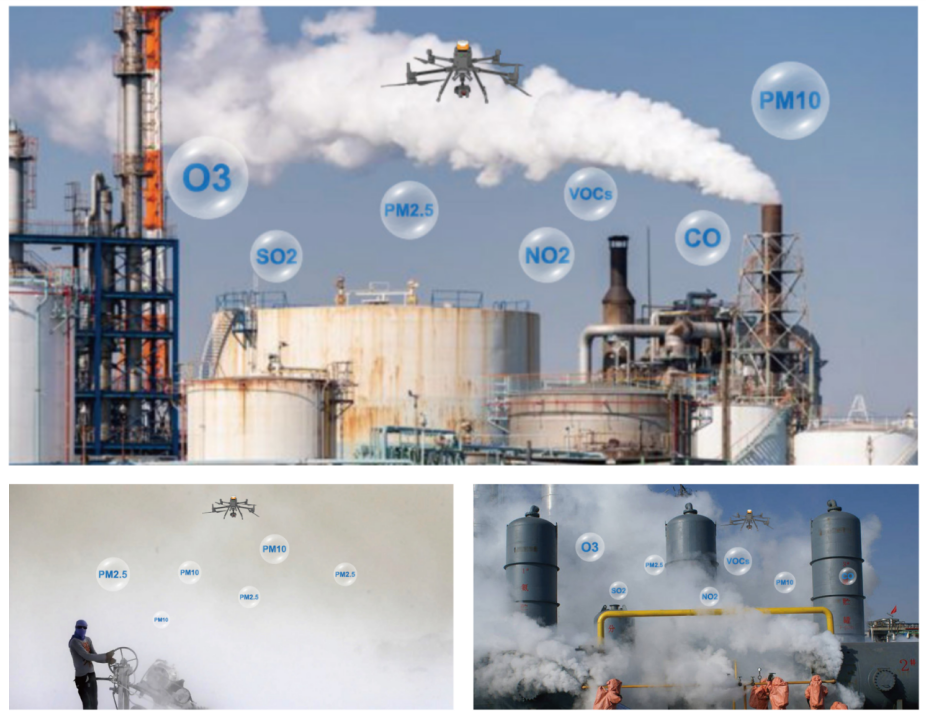
- Real‑time monitoring of multiple pollutants including PM2.5, PM10, SO₂, NO₂
- Uses sensors with fast response and high detection sensitivity for more reliable data
- Real‑time data analysis and assessment via sensor network and intelligent platform
- Supports rapid identification of toxic, hazardous, flammable, and explosive gases
- UAV‑mounted for flexible operation, suitable for complex and high‑risk environments.
In situations of sudden pollution, environmental enforcement, or large‑scale inspections, the GF910 can quickly answer the key question: Where is the pollution? The system visualizes monitoring data and provides accurate air quality information to environmental authorities, enterprises, and the public, assisting in timely remedial actions. GF330 Infrared Gas Analyzer
Greenhouse Gas Monitoring Solution: Supporting the "Dual Carbon" Strategy
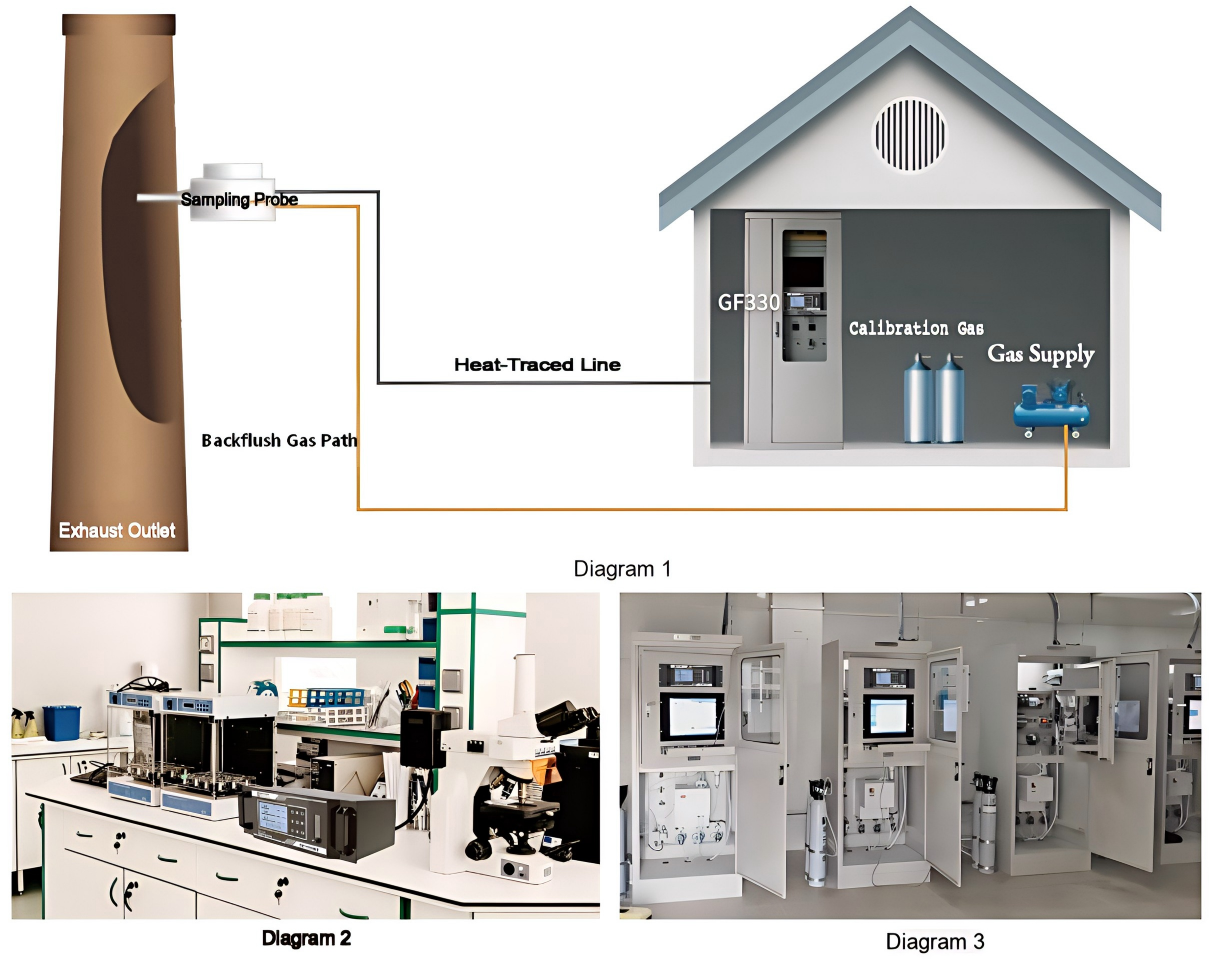
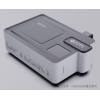
- Continuously measures gas concentrations of SO₂, NO, CO, CO₂, CH₄, N₂O, O₂, SF₆, etc.
- Can measure multiple gas components simultaneously
- Supports 4‑20 mA analog output, RS232, RS485, Ethernet, and other data output methods
- Available in explosion‑proof and non‑explosion‑proof models, adaptable to both hazardous and non‑hazardous conditions
- Simple operation, quick setup and convenient operation; warm‑up time depends on the sensor
- Automatic calibration, fault self‑diagnosis, stable performance
- Large‑screen LCD interface for parameter setting, measurement, and calibration via menu
- Customizable range; gas concentration units switchable between ppm and mg/m³.
The GF330 answers another key question: How severe is the pollution? Monitoring data can be uploaded in real time to environmental management platforms for quick access and analysis by regulators, making greenhouse gases "measurable, manageable, and controllable", supporting green and low‑carbon development.
04 Protection Begins with "Seeing"

On this important occasion of Earth Day (April 22), we rethink the relationship between people and the environment. Invisible gas risks should no longer be blind spots in governance. With spectral technology as its core, Optosky uses advanced monitoring equipment and data capabilities to make every change in the air traceable. From air quality to greenhouse gases, from rapid detection to precise analysis, we turn "invisible risks" into truly "visible protection". If you are concerned about air quality monitoring, pollutant gas monitoring, or greenhouse gas management, please contact us to obtain gas monitoring solutions and case support better suited to your scenario. We look forward to working with more industry partners to protect the blue sky through the power of technology.
For more information, please contact:Email: optoskyphotonics@gmail.comWeb: www.optosky.net


Search
Categories
Popular Posts


Latest Posts







Comments: 0
No comments