
Your shopping cart is empty!
Scientific-Grade UV-Vis Spectrometer

Scientific-Grade UV-Vis Spectrometer
5
8
Availability: In Stock
Scientific-Grade UV-Vis Spectrometer
Product Code: ATP6500
application
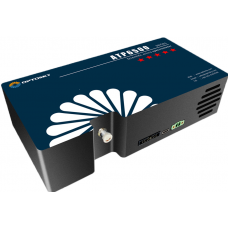
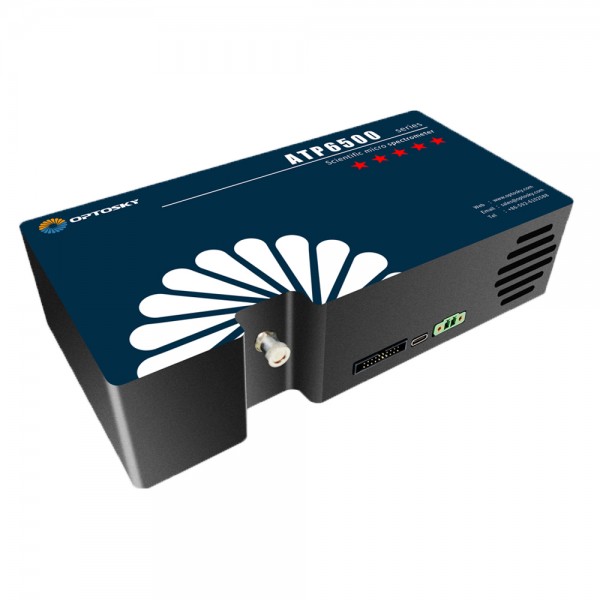
- The ATP6500 is an ultra-high-performance, cooled, miniature fiber optic spectrometer developed by Optosky, reigning supreme in performance. It utilizes a 1024 x 64 pixel cooled back-thinned linear CCD. This CCD offers the largest dynamic range and employs semiconductor cooling technology to reduce the dark current during operation. The CCD can operate in a set constant temperature environment (as low as -15°C), significantly reducing sensor noise and achieving an excellent signal-to-noise ratio (approximately twice that of comparable competitors). This also enhances the measurement reliability of the ATP6500, ensuring measurement results remain unaffected by ambient temperature changes.
- Simultaneously, Optosky has specially customized an ultra-low-noise CCD signal processing circuit for the ATP6500, with quantization noise less than 5 counts, representing the best level in the industry. The ATP6500 can accept light input via SMA905 fiber optic cable or free-space light and outputs the measured spectral data via USB 2.0 or UART port. The ATP6500 only requires a 5V DC power supply, making it very easy to integrate and use.
- Standard Cooled CCD, Cooling Temperature -15°C
- Deep Cooled CCD, Cooling Temperature -70°C
- Detector: Back-thinned CCD (can be cooled to a minimum of -70 °C)
- Detector Pixels: 1024 x 64
- Ultra-low-noise CCD signal processing circuit
- Quantum Efficiency: >90%
- Ultra-high Signal-to-Noise Ratio & Dynamic Range
- Spectral Range: 190-1100nm (widest 700nm)
- Spectral Resolution: 0.05-3 nm (depends on spectral range, slit width)
- Optical Structure: Crossed Czerny-Turner (C-T)
- Integration Time: 1ms-65s
- Power Supply: DC 5V±10% @ <2.3A
- 18 bit, 570KHz A/D Converter
- Light Input Interface: SMA905 or Free Space
- Data Output Interface: USB2.0 (High Speed) or UART
- 20-pin Dual Row Programmable Expansion Interface
- Biological fluorescence measurement
- Raman spectrometer
- Microscale, fast spectrophotometer;
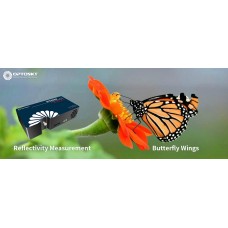
- Transmittance measurement;
What are scientific-grade spectrometer from Optosky?
ATP6XXX scientific-grade spectrometer represent the highest performance of uv,vis micro spectrometer.
ATP6500 cooled FFT-CCD, crossed C-T replace QE65 Pro, high sensitivity, high quantunm efficiency>90%, super SNR & Dynamic range, cooled down to -20℃
ATP6500T3 3-stage TEC cooled, lowest noise &dark current, cooled down to -30℃
ATP6530 M-shape C-T, high resolution, low stray light, 2-stage cooling.
ATP6530T3 3-stage TEC cooled CCD, M-shape, lowest noise and dark current.
How is the detector cooling technology working?
Detector cooling technology, this is TEC, this is stage 1 cooling, this is stage 2 cooling, and this looks like tower is stage 3 cooling, what're these coolers working principle? It's actual PN knot, you can power on electricity to access from this side, here is cooling, and the heat is transferred to here is heating. heating can bring heat away can cool down the temperature. Through reverse current from left side, this position change to heating, and this side is cooling. If the current go in this side is cooling, opposit go in the other side is heating.
PN tube is here, TEC integrated inside make the sensor looks metal housing tougher, uncooled detector use plastic housing, the detector heat is relative small, no need to use metal.
What benefits can the cooled detector bring?
In the short integration time, the cooled or not has little influence, but the longer the integration time the cooled detector in -20 degree has smaller dark current, but in the room temperature has the bigger dark current.
next let's see dark noise and temperature curve, In -20 degree the dark noise is small, but in room tepmperature, the dark noise is so big, the dark current of uncooled detector is decades times higher than the cooled.
1st, dark current is smaller, the integration time can be longer, and 2nd, noise is small.
ATP6500 spectrometer can cooled down to -15 degree, and cooled integration time lasting 1.3hrs. ATP5020P spectrometer can cooled down to -5degree, and integration time last 10mins.
Why the cooled detector employs higher performance?
Let's take the ATP6500 for example, when cooled down to 100ms, dark current is only 80counts, 16bit A/D, noise is 7, when the integration is 10s, the dark current is 245, when the integration time is 10s, the noise is only 10, when the integration time is 60s, the dark current is only 1100, and the noise is only 30, it's ease to run over a hour, and noise level is so small, that's why the ATP6500 cost higher but quite reasonable for such good performance.
Why the cooled spectrometer size is longer?
The cooled spectrometer has longer size for being installed fans inside and ventilation port, 2nd cooled spectrometer has bigger power consumption, so it has external power port, common spectrometer can use USB connect, but cooled spectrometer shall have power port.
Why Optosky's spectrometers employs higher reliability than competiors?
Some competitors' optical bench being fasten on metal platform, the optical chamber and electrical chamber are completely divided, which can avoid electrical board volatile chemical polluting optical components, this optical bench is fasten direct on pcb, but Optosky optical bench is fasten on metal platform, you can see the alluminum alloy thermo expansion coefficiency is only 18, but pcb is over 155, the reliability has improved over 10 times.
Let's see our spectrometer test result that the intensity stability change rate is only 0.37%, long time stability is only 0.14% also very good figure testify high stability.
How many topology structure of optical path for a spectrometer?
There are commonly divided into 4 types of optical path, including crossed C-T, M-shape C-T, concave grating optical path, transmittance grating opitcal path.
Crossed C-T: ATP2000P,ATP2002, ATP2400, ATP1010, ATP5020P, ATP5040, ATP6500
M-shape C-T: ATP3030, ATP3034, ATP3330/4 ATP5030, ATP5034, ATP5330/4
Concave grating: ATP4230, ATP4020, ATP4050, ATP4070
let's see the M-shape optical path looks like a number "3", so our models uses the 3rd number "3" to indicate M-shape optical path models.
In generally, topology structure can decide resolution, sensitivity, stray light, and size of a spectrometer.
Crossed C-T topology structure employs better sensitivity and compact size.
M-shape C-T employs higher resolution and better stray light.
Concave grating optical path employs high stray light.
What are application of spectrometers?
1st, Environmental industries:
UV smoke analysis
Multi-parameters online water quality analysis
No reagenet online water quality analysis
2nd, Industrial Inspection:
Colorimeter, colors sorting
Emissivity,Transmittance Measure
Laser wavelength monitor
LED color temp sorting
Film thickness measure meter
Glass thick measure meter
Process Analysis Technology(PAT)
3rd, Biomedical industries:
spectrophotometer
Fully automatic biochemical analysis
Fluorescence Spectroscopy
4th, Scientific instrument
Fluorescence Spectroscopy;
Chemical Lighting
Photoluminescence
Electroluminescence
LIBS or Ionoluminence