
Your shopping cart is empty!
High Sensitivity & High Resolution Micro Spectrometer
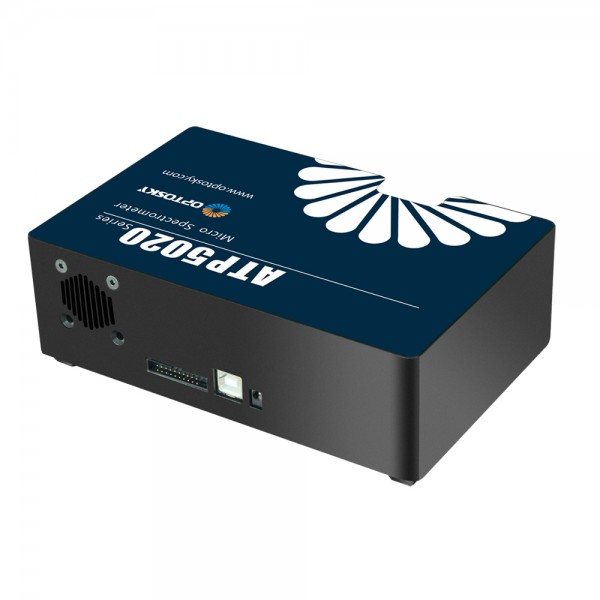

Optosky ATP5020 UV-Vis spectrometer employs the ultra-high performance, high-sensitivity, high resolution, and cost-effective model. The award-winner spectrometer is called cooled Maya, it can even replace Maya and QE65 in SNR, sensitivity, and resolution. ATP5020 spectrometer is ideal for Raman system well. It uses 2048 x 64 pixel, a back-thinned CMOS+Cooler (-5℃). Sensor noise is reduced, and SNR is almost 2 times higher than others. Increased reliability can remain measure result do not change with temperature.
High Sensitivity & High Resolution Micro Spectrometer
5
5
Availability: In Stock
High Sensitivity & High Resolution Micro Spectrometer
Product Code: ATP5020
application
Description:
Optosky ATP5020 UV-Vis spectrometer employs the ultra-high performance, high-sensitivity, high resolution, and cost-effective model. The award-winner spectrometer is called cooled Maya, it can even replace Maya and QE65 in SNR, sensitivity, and resolution. ATP5020 spectrometer is ideal for Raman system well. It uses 2048 x 64 pixel, a back-thinned CMOS+Cooler (-5℃). Sensor noise is reduced, and SNR is almost 2 times higher than others. Increased reliability can remain measure result do not change with temperature.
Customized design of CMOS+Cooler (-5℃) signal processing circuit built inside, Noise is lower can 3 counts is ahead of records in the industries.
ATP5020 spectrometer is designed with SMA905 optic fiber entrance connector or free space, and it outputs spectral data via USB2.0/UART
ATP5020 spectrometer is designed with SMA905 optic fiber entrance connector or free space, and it outputs spectral data via USB2.0/UART
Features:
- Detector:CMOS+Cooler (-5°C)
- Detector parameters:2048×64pixel, 14×14um Spectral
- range: 190-1100nm (max.800)
- Spectral resolution: 0.1-3 nm(depend on spectral range, slit width)
- Optical path:Crossed C-T
- Integration time:2ms-130s
- Power supply:DC 5V±10% @ <2.3A
- 18 bit, 570KHzA/D Converter
- Entrance connector:SMA905 connector or free space
- Output interface: high speed USB2.0 or UART
- 20 pins, dual rows programmable extension connector
| Detector | |
| Detector type | CMOS plus external cooling technology, TE-cooled to -5℃ |
| Spectral range | 180-1180 nm |
| Effective pixels | 2048 |
| Pixels dimension | 14μm×14μm |
| Full well capacity | 200 Ke- |
| Sensitivity | 6.5 uV/e- |
| Dark noise | 300 e-rms |
| Optical parameter | |
| Focal distance | 40/60mm |
| Optical resolution | 0.06-2 nm |
| Incident Interface | SMA905 connector,free space |
| Signal-to-noise | >1300:1 |
| Dynamic range | 50000 |
| Working temperature | -10°c to + 50°c |
| Numberical aperture | 0.11 |
| Working humidity | < 90% NC |
| Trigger | YES (IN and OUT) |
| Cooling temperature | -5°c |
| Full Well | 300 ke- |
| Scanning rate | < 1 kfps |
| Wavelength range | 180-1180nm |
| Slit Size | 50 μm (5, 10, 25, 50, 100, or 200 μm optional) |
| Optical Design | f/4 crossed asymmetrical Czerny-Turner |
| Physical parameters | |
| Dimensions | 170×110×52 mm^3 |
| Weight | 0.8kg |
| Sealing | Anit-sweat |
| Electrical parameter | |
| A/D conversion resolution | 18 bit |
| Integration time | 1 ms - 30 s |
| Interface | USB 2.0 (480MHz High speed) |
| Supply voltage | DC4.5 to 5.5 V (type @5V) |
| Operating current | <2.3A |
| Storage temperature | -30°c to + 70 °c |
Detector | |
Type | CMOS+Cooler (-5) |
Spectral range | 190-1100 nm |
Effective pixels | 2048×64 |
Pixel sizes | 14μm×14μm |
Full range | ~200 ke- |
Sensitivity | 6.5 uV/e- |
Dark noise | 6 e- |
Optical parameters | |
Wavelength range | 190-1100 nm |
resolution | 0.1-3 nm (depend on slit, spectral range) |
SNR | >8000:1 |
Dynamic range | 10000 :1 |
Operating temperature | -10-40 oC |
Operating humidity | < 85%RH |
Optical parameters | |
Optical path | f/4 crossed C-T |
Focal | 77.5 mm for incidence / 111.6 mm for output |
Entrance slit width | 5、10、25、50、100、150、200 μm (optional) Available in customized other widths |
Entrance connector | SMA905 Fiber optic connector, free space |
Electrical parameters | |
Integration time | 10 ms - 65 second |
Data output port | USB 2.0 |
ADC in-depth | 18 bit (Actual output16bit) |
Power supply | DC 5V±10% |
Operating current | <2.3A |
Storage temperature | -20°C to +70°C |
Operating temperature | -10°C to +40°C |
Physical parameters | |
Size | 170×110×52 mm |
Weight | 1.3 kg |
Sealing | Anti-sweat |
- Raman spectrometer
- Micro spectrophotometer,
- high-speed spectrophotometer
- Spectral analysis /radiation spectrophotometer/ spectrophotometric analysis
- Transmittance, absorbance, reflectance detection
- Wavelength detection
- LIBS
How to choose miniature raman spectrometer?
The ATP5020 is the lowcost micro raman spectrometer, whose customized for raman spectrometer employs high sensitivity and high resolution with cooled down to -5C.
What is the cooling temperature for the ATP5020?
It uses Hamamatsu s11639 plus external cooling technology to cool down to -5C proving constant measuring results.
What are High Resolution & High Sensitivity & TE cooled Spectrometer from Optosky?
ATP5100 Ultra-miniature, Cooled BT CCD, sized up to a coin.
ATP5040 crossed C-T, TE-cooled 4096 pixels CMOS external cooling, high sensitivity
ATP5020P crossed C-T, Hamamatsu CCD cooled, higher sensitivity, SNR & dynamic range is higher than Maya.
ATP5030P M-shape C-T, higher resolution and low stray light, Hamamatsu CCD
ATP5030 (2048pixels) & ATP5034 (4096pixels) CMOS+TE-cooler, M-shape C-T, high resolution
ATP5330 (2048pixels) & ATP5334 (4096pixels) Thin, cooled CMOS+TE cooled, M-shape C-T, super high resolution
How many topology structure of optical path for a spectrometer?
There are commonly divided into 4 types of optical path, including crossed C-T, M-shape C-T, concave grating optical path, transmittance grating opitcal path.
Crossed C-T: ATP2000P,ATP2002, ATP2400, ATP1010, ATP5020P, ATP5040, ATP6500
M-shape C-T: ATP3030, ATP3034, ATP3330/4 ATP5030, ATP5034, ATP5330/4
Concave grating: ATP4230, ATP4020, ATP4050, ATP4070
let's see the M-shape optical path looks like a number "3", so our models uses the 3rd number "3" to indicate M-shape optical path models.
In generally, topology structure can decide resolution, sensitivity, stray light, and size of a spectrometer.
Crossed C-T topology structure employs better sensitivity and compact size.
M-shape C-T employs higher resolution and better stray light.
Concave grating optical path employs high stray light.