
Your shopping cart is empty!
micro spectrometer

Availability: In Stock
micro spectrometer
Product Code: ATP5200
application
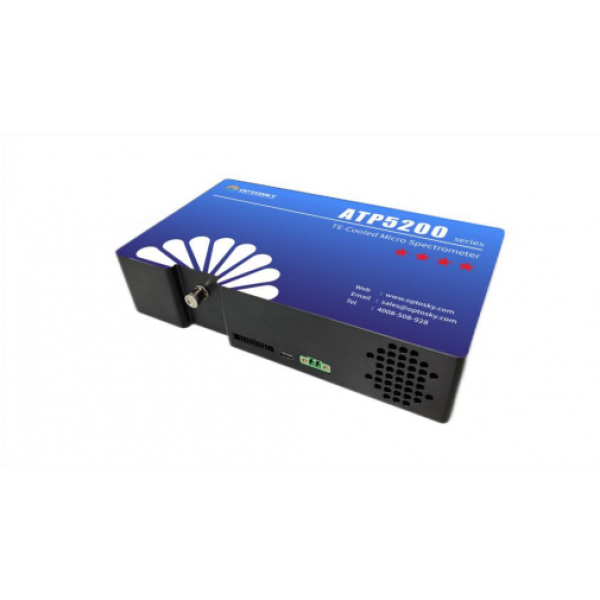
ATP5200 is the fifth generation of TE-cooled high performance spectrometer, which is self-developed by Optosky. It uses a back-thinned TE-cooled linear CCD with a semi-conductor cooling technology. The CCD can set in constant temperature environment (up to -10 degree), which greatly reduces sensor noise at an excellent
signal-to-noise ratio (about 2 times higher than competitors level), and it improves the reliability, so the measurements results can not change with the ambient temperature.
Meanwhile, it uses lowest noise CCD signal processing pcb to reach a noise less than 3 counts, which still the best low noise level.
The ATP5200 can receive SMA905 fiber optic input or free-space light to output spectral data via USB2.0 or UART port. It connects to 5V DC power supply, easy-to-integrate to wide industrial spectroscopy application.
| Detector | |
| Detector type | ATP5200/ATP5200-4: Linear array CCD ATP5200P/ATP5200R: Area array back-thinned CCD |
| Spectral range | 180-1180 nm |
| Effective pixels | ATP5200: 2048 ATP5200-4: 4096 ATP5200P/ATP5200R: 2048×64 |
| Dynamic range | ATP5200/ATP4500-4: 10000: 1 ATP5200P/ATP5200R: 15000: 1 |
| Pixels dimension | ATP5200: 200μm×14μm ATP5200-4: 200μm×7μm ATP5200P/ATP5200R: 14μm×14μm |
| Optical parameter | |
| Focal distance | 98 mm for incidence / 107 mm for output |
| Optical resolution | 0.01-3 nm (Depend on range & slit) |
| Incident Interface | SMA905 connector,free space |
| Signal-to-noise | ATP5200/ATP4500-4: 450:1 ATP5200P/ATP5200R: 15000: 1 |
| Working temperature | -10°c to + 50°c |
| Cooling temperature | -5°c |
| Wavelength range | 180-1180nm |
| Slit Size | 5, 10, 25, 50, 100, 150, 200 μm (optional) |
| Optical Design | F/4 crossed asymmetrical Czerny-Turner |
| Physical parameters | |
| Dimensions | 208×120×47 mm^3 |
| Weight | 1.5-1.7kg |
| Electrical parameter | |
| A/D conversion resolution | ATP5200/ATP4500-4: 16 bit ATP5200P/ATP5200R: 18 bit(Output 16 bit) |
| Integration time | ATP5200/ATP4500-4: 400μs~ 10s ATP5200P/ATP5200R: 5 ms - 30 min |
| Interface | USB 2.0 |
| Supply voltage | DC 5V±10% |
| Operating current | <2.3A |
| Storage temperature | -20°c to + 70 °c |
- Detector: Back-illuminated CCD (cooled to -10 ℃)
- Detector pixels: 2048 pixels
- Special optimization for UV or IR: UV optimization: ATP5200P / Infrared optimization: ATP5200R
- Ultra-low noise CCD signal processing circuit
- Maximum spectral range: 190-1100 nm(maximum width of 900 nm)
- Spectral resolution: 0.1-3 nm
- Optical path structure: cross C-T
- Integration time: 10ms-65s
- Power supply: DC 5V±10% @ <2.3A
- ADC bits depth:18 bit, 570KHz ADC
- 20-pin double-row expansion interface
- Light connector: SMA905 or free space
- Output data port: USB Type-C (High speed) or UART
- Raman spectrometer, online Raman analysis
- Micro volume spectrophotometer
- Weak fluorescent light detection
- Reflectance, Transmittance, Absorbance detection
- Fruit Sorting
How to choose miniature raman spectrometer?
The ATP5020 is the lowcost micro raman spectrometer, whose customized for raman spectrometer employs high sensitivity and high resolution with cooled down to -5C.
What is the cooling temperature for the ATP5020?
It uses Hamamatsu s11639 plus external cooling technology to cool down to -5C proving constant measuring results.
What are High Resolution & High Sensitivity & TE cooled Spectrometer from Optosky?
ATP5100 Ultra-miniature, Cooled BT CCD, sized up to a coin.
ATP5040 crossed C-T, TE-cooled 4096 pixels CMOS external cooling, high sensitivity
ATP5020P crossed C-T, Hamamatsu CCD cooled, higher sensitivity, SNR & dynamic range is higher than Maya.
ATP5030P M-shape C-T, higher resolution and low stray light, Hamamatsu CCD
ATP5030 (2048pixels) & ATP5034 (4096pixels) CMOS+TE-cooler, M-shape C-T, high resolution
ATP5330 (2048pixels) & ATP5334 (4096pixels) Thin, cooled CMOS+TE cooled, M-shape C-T, super high resolution
How many topology structure of optical path for a spectrometer?
There are commonly divided into 4 types of optical path, including crossed C-T, M-shape C-T, concave grating optical path, transmittance grating opitcal path.
Crossed C-T: ATP2000P,ATP2002, ATP2400, ATP1010, ATP5020P, ATP5040, ATP6500
M-shape C-T: ATP3030, ATP3034, ATP3330/4 ATP5030, ATP5034, ATP5330/4
Concave grating: ATP4230, ATP4020, ATP4050, ATP4070
let's see the M-shape optical path looks like a number "3", so our models uses the 3rd number "3" to indicate M-shape optical path models.
In generally, topology structure can decide resolution, sensitivity, stray light, and size of a spectrometer.
Crossed C-T topology structure employs better sensitivity and compact size.
M-shape C-T employs higher resolution and better stray light.
Concave grating optical path employs high stray light.